
Whole‑Home Flooring Replacement — Ajax, Ontario
Complete hardwood, tile and LVP upgrade across a two‑storey Ajax home with tight access and winter timing.
- 1
Survey, moisture testing and detailed scope
Before work began we performed ASTM F2170 relative humidity tests in the concrete slab and checked plywood for movement and rot. That data determined whether to install a vapour barrier, select a self‑levelling product (cementitious underlayment) or proceed with direct‑bond engineered flooring, avoiding the 'install now, fix later' problem hidden in low quotes.
- 2
Selective demolition and protection
We removed finishes carefully — nails, thresholds and adhesives — and protected staircases and millwork with rosin paper and rigid corner guards. Controlled demolition keeps airborne dust down (important during Ontario’s shoulder seasons) and prevents damage to finishes that would create extra costs later.
- 3
Subfloor prep per material requirements
For the plywood areas we re‑screwed and sanded gaps, then applied a 3mm plywood patch where joist deflection exceeded manufacturer limits. On the slab, we cleaned, primed and poured a latex‑modified self‑levelling compound to create the flatness tolerances required by large‑format porcelain and waterproof LVP.
- 4
Installation: products and techniques
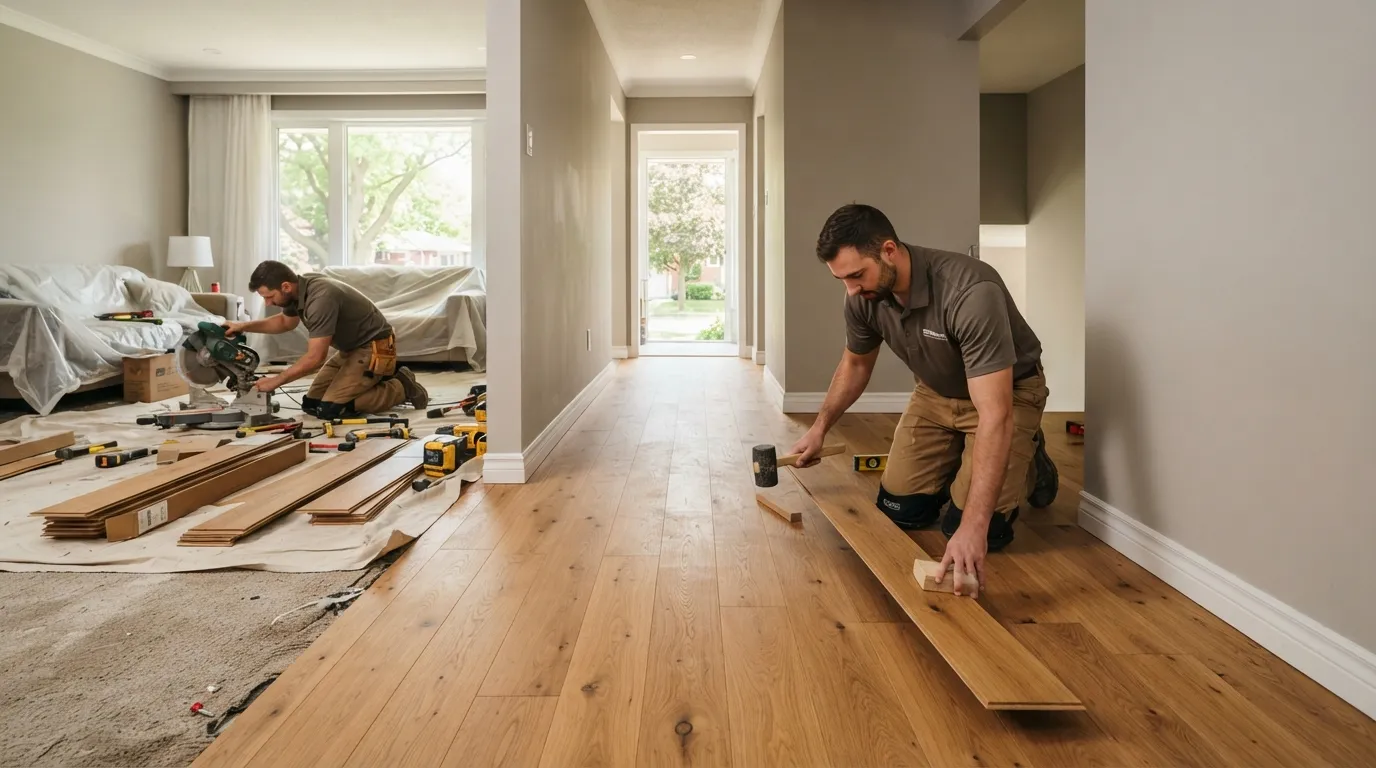
Living areas received 3/4" engineered oak installed with floating method and 120° staggered joints using a T&G locking system; kitchen and mudroom got rectified 12"x24" porcelain tile with a minimum 1/8" grout joint and epoxy grout in wet zones. The basement received a gluedown 8‑mm waterproof luxury vinyl plank with a peel‑and‑stick perimeter seam to maintain manufacturer warranty.
- 5
Finish carpentry, transitions and quality checks
We installed matching quarter round and 3/4" nosing on stairs, used Schluter transitions at tile‑to‑hardwood edges, and a rubber reducer at exterior doors for weather sealing. A full walk‑through checked flatness, expansion gap compliance and grout cure times; we documented measurements and photos for the client's file and product warranties.
Frequently Asked Questions
How long does a whole‑home flooring replacement take?
Typical timelines depend on square footage and trades involved: expect one to three weeks for moderate‑size homes, longer if structural subfloor fixes or extended grout cure times are required. We schedule by task to avoid idle crews and provide a phased plan so you know when each area will be usable.
How disruptive will it be to live in the house during the work?
There is some disruption: demolition dust, temporary lack of use for rooms and staged materials on site. We use containment, daily cleanup and targeted phasing so families in Ajax can continue to use parts of the home safely during the project.
How do you decide between hardwood, tile and LVP?
We match materials to room performance needs: tile for high moisture and heat tolerance, engineered or solid hardwood for aesthetics and refinishing potential, and waterproof LVP where moisture or installation economics rule. We back recommendations with moisture testing and manufacturer limits to avoid costly callbacks.
When is a full replacement necessary versus spot repairs?
Full replacement is sensible when subfloor variability, chronic moisture, major layout changes or mismatched finishes exist. Spot repairs can work for isolated issues, but whole‑home jobs often save money long‑term by creating a consistent, warrantied system rather than piecemeal fixes.